

10 Habits That Will Actually Make You Rich in 2025 | Simple Wealth-Building Strategies
Forget the 18-hour grind. Forget the perfect morning routine. That’s not what makes you rich.
What actually builds wealth? Tiny, simple habits you stick to every day. That’s it. Not glamorous. Not flashy. Just small things that compound over time until success becomes almost inevitable.
And I’m not talking theory here. I’ve built 19 companies. I’ve sold three of them for more money than I’ll ever need. And looking back, it wasn’t because I out-worked everyone or had some magic secret. It was because I built the right habits.
So in this video, I want to share with you the 10 habits that actually made me rich. Habits you can literally start using today to make your life and your business better.
1. Keep It Simple (Complexity Kills Wealth-Building Strategies)
The first habit you need to learn if you want to get rich is simple: keep it simple.
And I can tell you from personal experience, this one is way harder than it sounds.
See, when you’re excited about building a business—or even just starting a side hustle—your brain will try to make everything complicated. You’ll think you need 10 features, a huge team, a fancy logo, the perfect website. But complexity kills momentum. Simplicity is what gets ideas off the ground.
Here’s what I mean. When I built one of my companies, I didn’t try to solve every problem under the sun. I focused on one clear pain point. That was it. That focus is what allowed it to actually work.
And the same lesson shows up everywhere:
- Amazon? Started by just selling books. Nothing more.
- WhatsApp? Just simple messaging.
- Dropbox? Just file storage, one button that worked.
They didn’t start with a thousand features—they started with one thing that mattered, and they did it really well.
Another thing: stop trying to jump from zero to a million. Before you dream about earning a million dollars, figure out how to earn $1 profit. If you can sell a T-shirt and make a single dollar, you’ve proven that your idea works. Do that again and again, and scaling becomes possible. But if you can’t make one dollar, you won’t make one million.
And here’s my favorite test: explain your idea to an eight-year-old. If they don’t get it, it’s too complicated. When I explained my platform to my own son, I just told him, “You press a button, you get help. You press a button, you give help.” He got it instantly. That’s the power of keeping it simple.
👉 Pro tip: Try boiling your idea down to one short sentence. If you can’t, it means you’re still overcomplicating it. Simplify until it feels obvious.
2. Do One Thing Exceptionally Well (Daily Money Habits That Compound)
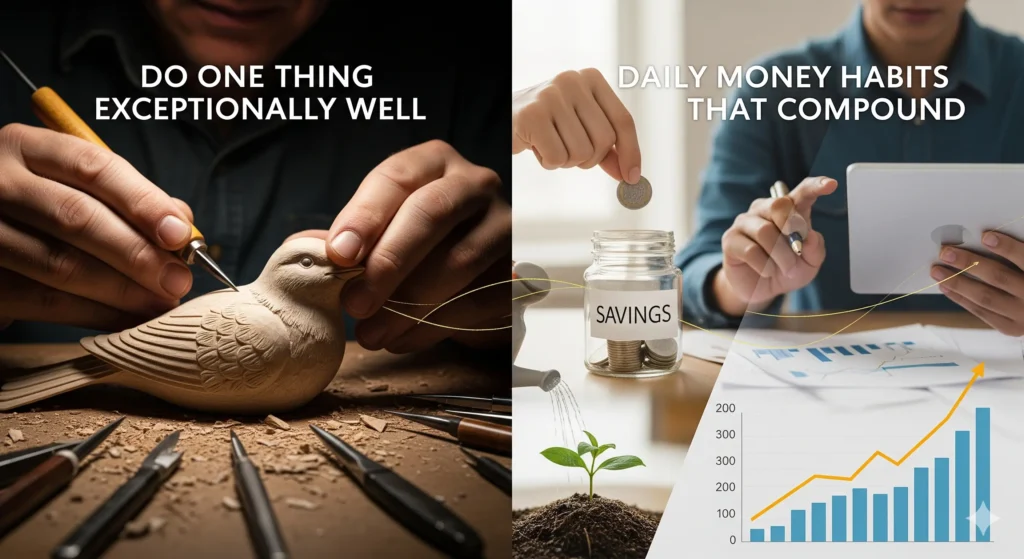
Here’s another habit that changed everything for me: do one thing really, really well.
Now, I get it—multitasking feels productive. You’ve got 10 tabs open, juggling different projects, chasing five opportunities at once. But here’s the truth: multitasking almost never creates real results. The people who win big are the ones who pick one thing, master it, and become world-class at it.
Take WhatsApp for example. When they started, they weren’t doing calls, payments, or stories. They had one focus: messaging. And they did it so well that millions of people told their friends, “Hey, you’ve got to use this.” That’s the power of focus.
The trap most entrepreneurs fall into is what I call “shiny object syndrome.” Something new comes along—AI, Web3, whatever the hot trend is—and they drop everything to chase it. Don’t do that. If it doesn’t serve the one problem you’re solving, say no. In fact, saying no more often than yes is one of the most valuable skills you can learn.
Another key part of mastery is building systems before you expand. If you’ve got one product that works, create a repeatable process around it. Document it. Automate what you can. Once that machine is running smoothly, then you can think about adding something new. But if you try to launch 10 features at once, you’ll just end up with 10 half-broken ideas.
And finally—don’t measure progress by how many hours you worked. Working 12-hour days doesn’t guarantee success. What matters is results. Did you close a sale? Did you deliver value? Did you actually move the needle? That’s the only measure that counts.
3. Don’t Be the Bottleneck (Simple Habits for Success in Business)

This is a mistake I made early in my career, and I see a lot of entrepreneurs making it too: they become the bottleneck.
Here’s what I mean. If your side hustle or business only works when you are working, then the second you get sick, take a break, or simply run out of hours, the whole thing stops. That’s not a business—that’s a job you built for yourself.
The truth is, if you want to grow, you have to design your business so it doesn’t rely entirely on you. And that starts with systems.
The first step is simple: document everything you do. Don’t keep it all in your head. Use tools like Notion or even quick Loom videos to show step-by-step how you handle tasks. When you do this, anyone else can pick it up without asking you a hundred questions.
Second, delegate the stuff you’re not great at. If you’re not an accountant, hire one. If organizing drains you, get a VA. And if you can’t afford to hire yet, start small—there are affordable software tools that can automate repetitive jobs. The point is to stop doing everything yourself.
Third, learn to trust people with small decisions. If you micromanage every detail, you’ll burn out and your team will never grow. When you give someone the freedom to decide, they also take responsibility. That’s how ownership is built.
And finally, ask yourself this question every week: “What am I holding up right now?” If the answer is “a lot,” then it’s time to step aside and let someone else run with it. Because if you keep being the bottleneck, you’ll slow everything down.
👉 Pro tip: Next time you find yourself repeating the same task, record yourself doing it. Hand that video to someone else. Congratulations—you just removed one bottleneck.
4. Obsess Over Sales (Sales = Oxygen for Financial Freedom)

Look, here’s the truth — without sales, you don’t have a business. You could have the best product in the world, the slickest logo, the coolest idea… but if nobody’s buying, it’s dead. Sales is oxygen. No sales, no survival. Simple as that.
And I know a lot of people roll their eyes at sales. Maybe school taught you that salespeople are pushy or “sleazy.” That’s completely wrong. Sales is just solving problems. That’s it. You figure out what someone needs, and you show them how you can help. That’s sales.
So here’s how I think about it:
First, spend 80% of your time with customers. Talk to them. Listen to them. Don’t sit there for four months perfecting a product without asking a single customer what they actually want. I’ve seen people do this — and then wonder why no one buys.
Second, remember sales is storytelling. It’s not pressure. You don’t need to be the loudest person in the room. You just need to say: “This is who I am. This is what I built. And this is why I believe you need it.” If you’ve done the work to find out they actually do need it, that conversation gets really easy.
Third, track your daily outreach. For me, that might mean: 10 DMs, 5 phone calls, 2 meetings. Every single day. And let me tell you, most people who complain they can’t sell? They’ve probably only reached out to two people and gave up. That’s not selling. That’s just hoping.
And finally — you’ve got to get comfortable with rejection. Everyone hates hearing “no,” but rejection is just feedback. It’s a clue. Think about Dyson — 5,000 failed prototypes before he got it right. If someone doesn’t buy, ask why. Learn from it. Adjust. Every “no” gets you closer to a “yes.”
👉 Pro tip: Create a simple scoreboard for yourself. Write it on paper if you have to: how many people you reached out to today, how many conversations you had, how many rejections you got. Do that every single day, and you’ll start to see results.
5. Start With People, Not Products (Side Hustle Success Tips)

This one’s big: don’t start with the product, start with people.
Because here’s the truth — people don’t buy from brands, they buy from people they trust.
I’ve built enough businesses to know: if you don’t have the right people around you, I don’t care how good your product is, it’s not going to work.
So here’s what that looks like in real life:
First, if you’re looking for a co-founder or partner, don’t just go hunting for someone with a skill you’re missing. That’s what most people do. But skills can be learned. What really matters is values. Do they care about the same things you care about? Do they believe in the same mission? Because if you’re not aligned there, it’ll fall apart sooner or later.
Second, build your network before you need it. Don’t wait until your business is struggling to go meet people. Start now. Go on LinkedIn. Go to local meetups. Join online communities. Surround yourself with people who care about the same problems you’re trying to solve.
Third, talk to customers before you build anything. One of my favorite examples is Dropbox. Before they had a working product, they literally just made a simple demo video showing how it would work. And guess what? Hundreds of thousands of people signed up. That’s proof of demand before writing a single line of code. Imagine how much time that saved.
And the last piece — find mentors smartly. Stop DM’ing people asking, “Will you be my mentor?” It doesn’t work. Instead, follow people who are already putting out free knowledge. Most of what you need is already in their content. And if you really want to reach out, ask one smart, specific question. You’ll be surprised how many people actually reply.
👉 Pro tip: Go DM five people today who are ahead of you in your field. Don’t ask for mentorship. Just ask them one clear, thoughtful question. That’s how real relationships start.practitioners today with one specific question.
6. Don’t Rush to Raise Money (Bootstrap Wealth-Building Strategies)

Alright, let’s talk about raising money — because this is where a lot of people get brainwashed. TV shows like Shark Tank or Dragon’s Den make it look like the first thing you need to do is pitch an investor and get a big check. And honestly? That’s one of the fastest ways to kill your business.
Here’s the truth: money doesn’t fix a weak idea. If your product doesn’t have demand, all investment will do is accelerate your failure.
So what should you do instead? Bootstrap. Start small, start scrappy, and prove that people actually want what you’re selling. That’s how most real wealth-building journeys begin.
Tesla is a great example. Before Elon Musk delivered a single car, they had people pre-ordering years in advance. That’s proof of demand. You can do the same thing with your idea on a smaller scale. Put up a waitlist page. Collect emails. Even better, get people to pay deposits. If no one’s willing to commit, that’s your answer right there.
And here’s why bootstrapping matters: as soon as you take investor money, you lose a piece of your freedom. Investors aren’t charities — they want their money back, and they want profit. If you don’t even know yet if $1 spent will bring you $3 back, you’re basically giving away equity for nothing. And trust me, equity is the most expensive thing you’ll ever give away.
So here’s my rule: only raise money when you’ve already proven the math works. If you know every $1 in marketing turns into $3 revenue, then sure, raising money makes sense because you can scale faster. But if you don’t have that clarity, you’re just gambling with your business and your freedom.
👉 Pro tip: Before you think about investors, test your idea with something as simple as a landing page and a waitlist button. If strangers sign up, you’re onto something. If they don’t, back to the drawing board.
7. Take Advice Only From Practitioners (Success Habits of Entrepreneurs)

Here’s another big one: be careful who you take advice from.
The internet is full of people telling you how to build a business, how to get rich, how to scale a startup. But here’s the question you should always ask: “Has this person actually done what I want to do?”
If the answer is no, stop listening. Seriously.
See, there’s a big difference between a practitioner and a theorist. A practitioner has been in the trenches. They’ve built something, failed at something, learned the hard way, and actually got results. A theorist? They’ve just read about it, maybe even taught it, but never actually lived it. And when it comes to business, theory and reality are two very different games.
I’ll give you an example. I’ve seen consultants charge thousands to “fix” a company, and yet they’ve never built a company themselves. They can give you slides, frameworks, and buzzwords—but when real problems hit, they don’t know what to do. On the other hand, someone who’s built and scaled a business? Even if they failed a few times, they’ve got scars and lessons you can actually use.
And even when you do get advice from someone credible, here’s the key: test it in the real world. Don’t just take someone’s word as gospel. Go out and ask customers. Try the strategy. See if it works for your business, not just theirs.
👉 Pro tip: This week, instead of listening to another “inspirational” podcast or motivational clip, go have three real conversations with potential customers. I promise you, the feedback you get from them will be more valuable than hours of generic advice.s.
8. Build Around Purpose (Financial Freedom Habits That Last)
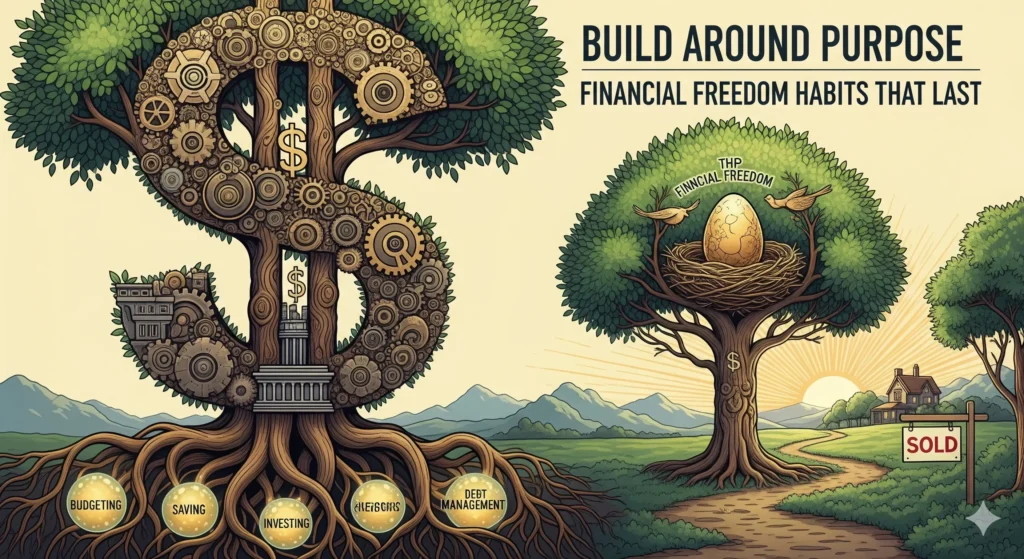
Let me tell you something I learned the hard way: money fades, but purpose lasts.
If the only reason you’re building your business is to make money, you’re going to burn out. Because here’s the thing—when it gets tough (and it always gets tough), money won’t keep you going. But if you’re working on something you actually care about, something that connects to your values, you’ll stick with it.
I’ve started companies just for the money before. And yeah, sometimes they worked okay… but I didn’t love it. I wasn’t excited to wake up and fight through the hard days. Compare that to what I’m doing now—trying to fix education, trying to help people build businesses. That fires me up. That’s why I’ve been at it for years. Purpose gives you energy that money can’t.
So here’s how you build around purpose:
First, be brutally honest with yourself about why you’re doing this. Is it just for cash? Or is it because you believe the world needs this problem solved? If it’s just about money, you’ll quit the first time it gets hard.
Second, make sure it aligns with your values. If you’re running a business that feels off in your gut, it’s not going to last. You’ll always feel that tension. I’ve turned down opportunities that could have made a lot of money—because they didn’t sit right with me.
Third, share your story. People don’t just buy products, they buy you. They want to know why you care, why this matters to you. That’s what makes them trust you.
And finally, let purpose guide your tough decisions. At some point, you’ll get offered shortcuts—easy money, quick wins. But if they go against your mission, don’t take them. I promise you, you’ll regret it later. Stick with the path that aligns with your purpose.
👉 Pro tip: Sit down and write your story in 200 words. Why are you doing this? Why does it matter to you? Put that on your website, on your social media, and in your pitch. That story is what people will connect with.
9. Build Community (Community-Driven Business Growth)
Alright, let me tell you this… community is everything. Seriously. In 2025, if you’re building a business and you’re not building a community, you’re already falling behind. Because look, AI can copy your product tomorrow. Competitors can copy your website. But what they can’t copy? Your people. The ones who actually believe in you, who feel like they’re part of what you’re building. That’s your moat.
And you don’t need thousands of people to start. Start small. When I built some of my businesses, it literally began with a handful of people who cared. Five, ten early supporters. That’s all it takes to get the fire going. Throw them in a WhatsApp group, a Discord, a Slack channel—whatever. The tool doesn’t matter, the connection does.
And here’s the key: don’t just take. Give. Share resources, share tips, share introductions. Help them even if it doesn’t make you money right away. People can feel if you’re just trying to extract value, and they’ll walk away. But if you’re genuinely helping, they’ll stick around.
Then you’ve got to create spaces where they can connect with each other. Online challenges, little meetups, even a group Zoom call. Because when people feel like they belong to something bigger, that’s when they become your people.
And listen to them. Your community will tell you what they want before you even realize it. LEGO is a perfect example. Their fans were making Star Wars sets before LEGO ever thought about it. The company paid attention, and boom—Star Wars LEGO became a billion-dollar idea. That’s the power of listening to your people.
👉 Pro tip: Don’t overthink this. Start a small WhatsApp group. Add your first ten supporters. Talk to them. Ask them what they need. That’s how it starts. That’s how you build something no competitor can touch.
10. Hire for Heart, Not Just Skills (Money Habits of Successful People)
Alright, last one — and honestly, this is one of the most important lessons I’ve learned. Hire people with heart, not just skills.
Look, skills are great. You need them, of course. But skills can be taught. What you can’t teach is passion, hunger, loyalty, the stuff that actually makes someone fight for the mission with you.
I’ve seen this play out so many times. You hire someone who’s brilliant on paper, amazing CV, top of their field… but they don’t care about what you’re building. They’re just there for the paycheck. And you know what happens? Every six months they’re asking for more money, or they’re halfway out the door looking for the next job. It drains you, and it drains the team.
On the other hand, I’ve hired people who, at the start, weren’t even that skilled. They didn’t have the “perfect” background. But they had heart. They cared about the mission. They believed in what we were doing. And because of that, they worked like crazy to learn, to grow, to get better. Those are the people who stick, those are the people who become the backbone of your business.
So when you’re hiring, here’s what I do:
- First, I check if they actually care about the mission. Do our values align? If they don’t, it won’t work.
- Second, I ask questions that reveal character. My favorite is: “If I gave you $10 million today, what would you do with it?” The answer tells you a lot about what drives them.
- Third, I reward loyalty. If someone sticks with me through the tough times, I promote them. I look after them. Because that kind of consistency is rare.
- And finally, I focus on culture. Skills matter, yes, but culture eats strategy for breakfast. If your culture is strong, the skills will follow.
👉 Pro tip: In your next interview, add one question that digs into heart, not just skills. Ask something that shows you what the person values most. It’ll tell you more than their entire CV.
Key Takeaway: 10 Habits That Will Actually Make You Rich in 2025
Here’s what I want you to remember: you don’t need to work 18 hours a day, you don’t need to burn yourself out, and you don’t need some magic morning routine to succeed. That’s not what makes people rich.
What you really need are the small things — simple daily habits that compound over time. Keep things simple, focus on one thing, don’t let yourself become the bottleneck, and never forget that sales is oxygen. Build around people, build around purpose, create a community, and when it comes time to hire — hire people with heart.
Wealth doesn’t come from hustling yourself into the ground. It comes from stacking small, smart actions, day after day, until they turn into something big. That’s how you win.
Leave a Reply